
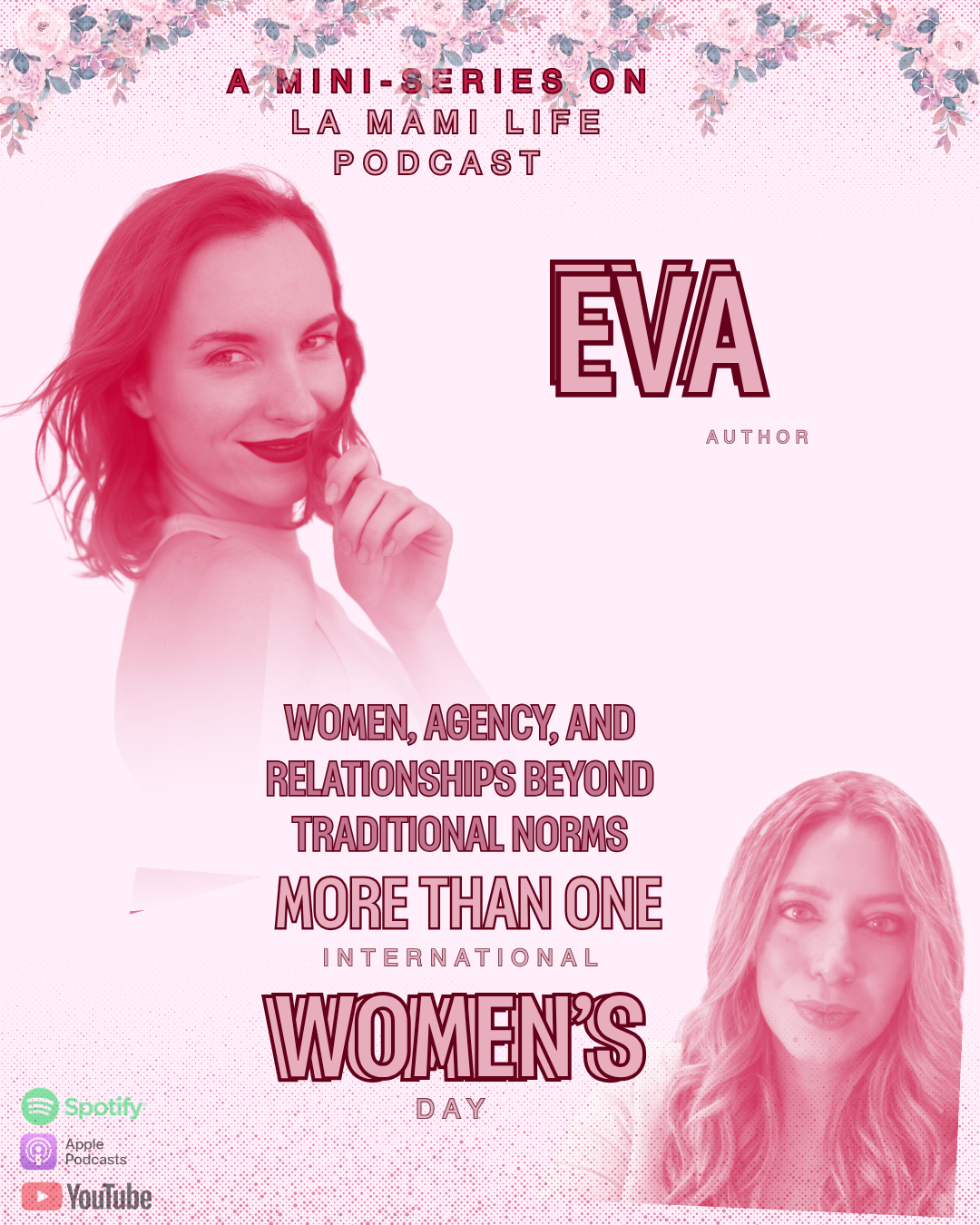
Part of the “More Than One International Women’s Day” Miniseries available on La Mami Life Podcast
There are conversations women are still expected to whisper about.
Not because they are unimportant.
But because they challenge the stories we have been handed about love, commitment, desire, and what a “good woman” is supposed to want.
This episode of La Mami Life Podcast, part of the More Than One International Women’s Day miniseries, opens the door to one of those conversations.
I sat down with Eva Almer, writer, marketing specialist, educator, and author of Non-Monogamy Storybook, for an honest and eye-opening discussion about ethical non-monogamy, women’s autonomy, jealousy, communication, and the right to define relationships on your own terms.
This was not a conversation about shock value.
It was a conversation about agency.

A Mother, a Writer, and a Woman with More Than One Identity
Eva describes herself the way many women probably would if given the space to tell the full truth:
she is a woman, a mother, a partner, a businesswoman, and an artist.
In her everyday life, she works in marketing for her family business.
But writing has long been part of who she is.
Before publishing in English, she had already written books in Ukrainian and spent years helping others express themselves through storytelling and copywriting. But over time, life shifted. Motherhood changed her. War in Ukraine changed her. The world of writing changed too.
And somewhere in the middle of all those transitions, she came back to something essential:
she is a writer because she has always needed to make sense of life through words.
Not just information.
Stories.
The Book Wasn’t Born From Theory. It Came From Real Life
What makes Non-Monogamy Storybook stand out is that it is not a traditional how-to guide.
It is built around real stories.
Twelve of them.
Some are from couples. Some are from solo polyamorous people. And rather than presenting one rigid model, the book offers a window into how different people navigate non-traditional relationships in real life.
Eva explained that the project came together naturally.
As she and her husband explored ethical non-monogamy in their own lives, they also began meeting others who had been quietly living this reality for years.
Some of them looked, from the outside, like what many would call a “normal family.”
Children. Stability. Long-term partnership.
And yet behind closed doors, they had built relationship models based on openness, consent, and communication rather than default tradition.
Over time, Eva realized she was no longer just living the questions.
She was gathering the stories.
Why This Topic Matters for Women Right Now
One of the strongest themes in the conversation was this:
women should not feel ashamed of their desires.
That does not mean every woman wants the same kind of relationship.
It does not mean ethical non-monogamy is for everyone.
But it does mean women deserve the freedom to ask honest questions about what they want, what feels aligned, and whether the relationship structures they were taught to accept actually reflect who they are.
Eva spoke about how, for years, many women have had to suppress parts of themselves to fit into expectations.
Be agreeable.
Be loyal.
Be grateful.
Be quiet.
Don’t ask too many questions.
Don’t want too much.
But modern womanhood is not just about work, motherhood, or sacrifice.
It is also about choice.
And that includes love.

Jealousy Is Not Always What We Think It Is
One of the most interesting parts of our discussion centered around jealousy.
For many people, jealousy is the immediate reason they dismiss any conversation about open relationships.
But Eva offered a more nuanced view.
In her experience, jealousy was deeply tied to fear.
Fear of being left.
Fear of not being enough.
Fear shaped by past wounds and broken trust.
What changed for her was not some magical disappearance of emotion.
It was the work of building self-confidence and security within herself.
She spoke about motherhood, career pauses, exhaustion, and the internal vulnerability that can come when your identity feels temporarily reduced to survival. Then, over time, she rebuilt her confidence through work, results, self-awareness, and the recognition that her worth did not depend on being chosen over another woman.
That shift is bigger than one relationship model.
It speaks to something many women need:
the ability to know they will be okay, no matter what.
Opening a Relationship Does Not Fix a Broken One
Eva was very clear about one thing:
ethical non-monogamy is not a tool to save a failing marriage.
If a relationship already lacks trust, respect, communication, or emotional safety, bringing more people into the dynamic does not solve the problem.
It magnifies it.
The comparison that came up in our conversation was a powerful one:
having children does not fix a broken marriage either.
The issue has to be addressed at its root.
That is why communication and mutual agreements matter so much. Eva shared that in her own relationship, she and her husband eventually sat down and explicitly talked through their boundaries, expectations, and what felt okay for each of them. Not because they had a perfect roadmap from the beginning, but because they had bumped into emotional limits and realized clarity was necessary.
That honesty became part of the foundation.
Rules, Boundaries, and the Conversations Most Couples Never Have
One of the most relatable takeaways from the episode is that many couples, even in monogamous relationships, never clearly define what is okay and what is not.
They assume.
They inherit.
They guess.
But assumptions can break trust just as easily as actions can.
Eva talked about how every relationship, monogamous or not, benefits from real conversations about boundaries, comfort levels, and expectations. What feels harmless to one person may feel deeply hurtful to another.
The point is not control.
The point is clarity.
And in a world where so many women are taught to suppress discomfort in order to keep the peace, that kind of clarity is radical.
Speaking Up, Even If It Starts in Private
Toward the end of the episode, I asked Eva what she would say to women who feel unseen, lost, or disconnected from themselves.
Her advice was simple, but powerful.
Build your inner security.
Know who you are.
Speak up.
Not necessarily to everyone.
Not all at once.
Not before you are ready.
But at least to yourself.
That may be the beginning.
Because before a woman can ask for a different life, a different relationship dynamic, a different level of honesty, or a different version of herself, she has to first admit what is true inside her.
And for many women, that is the hardest part.
Why This Story Matters in the “More Than One International Women’s Day” Miniseries
Our miniseries exists because women’s stories deserve more than one symbolic day of attention.
They deserve nuance.
Space.
Complexity.
Truth.
Eva’s episode matters not because it tells women what to do, but because it reminds us that women are allowed to question inherited scripts.
They are allowed to evolve.
They are allowed to want honesty.
They are allowed to build lives and relationships that reflect who they really are.
Even when those choices make other people uncomfortable.
If You’ve Ever Questioned the Rules…
Maybe this episode will resonate because you are curious about ethical non-monogamy.
Maybe it will resonate because you have felt jealousy and wanted to understand it more deeply.
Maybe it will resonate because you are tired of the narrow ways women are taught to think about relationships.
Whatever brings you here, this conversation is an invitation to reflect.
Not to judge.
Not to assume.
But to think more honestly about autonomy, love, and what it means to choose consciously.
Listen to the Full Episode
This episode is part of the More Than One International Women’s Day miniseries on La Mami Life Podcast.
Guest: Eva Almer
Book: Non-Monogamy Storybook find it on Amazon.
If this conversation resonated with you, listen to the full episode on Apple Podcasts, Spotify or on YouTube Podcasts.
And if you enjoyed this story, subscribe, leave a 5-star rating, and share it with another mami who would find this conversation meaningful.
Xoxo,
Julie
Escribió sobre las relaciones de las que muchas mujeres todavía no se atreven a hablar
Parte de la miniserie “More Than One International Women’s Day” disponible en La Mami Life Podcast
Hay conversaciones que todavía se espera que las mujeres tengan en voz baja.
No porque no sean importantes.
Sino porque cuestionan las historias que nos han enseñado sobre el amor, el compromiso, el deseo y lo que se supone que una “buena mujer” debe querer.
Este episodio de La Mami Life Podcast, como parte de la miniserie More Than One International Women’s Day, abre la puerta a una de esas conversaciones.
Me senté a hablar con Eva Almer, escritora, especialista en marketing, educadora y autora de Non-Monogamy Storybook, en una charla honesta y reveladora sobre no monogamia ética, autonomía femenina, celos, comunicación y el derecho a definir las relaciones en tus propios términos.
No fue una conversación para llamar la atención.
Fue una conversación sobre autonomía.
Madre, escritora y mujer con más de una identidad
Eva se describe de una manera con la que muchas mujeres probablemente se identificarían si tuvieran el espacio para contarlo todo:
es mujer, madre, pareja, empresaria y artista.
En su día a día trabaja en marketing dentro del negocio familiar.
Pero la escritura siempre ha formado parte de ella.
Antes de publicar en inglés, ya había escrito libros en ucraniano y llevaba años ayudando a otras personas a expresarse a través del storytelling y la escritura persuasiva. Pero con el tiempo, la vida cambió. La maternidad la cambió. La guerra en Ucrania la cambió. Y también cambió el mundo de la escritura.
Y en medio de todas esas transformaciones, volvió a una verdad esencial:
es escritora porque siempre ha necesitado entender la vida a través de las palabras.
No solo información.
Historias.
El libro no nació de la teoría, sino de la vida real
Lo que hace diferente a Non-Monogamy Storybook es que no es una guía tradicional de “cómo hacerlo”.
Está construido a partir de historias reales.
Doce en total.
Algunas son de parejas. Otras, de personas solopoly o poliamorosas. Y en lugar de presentar un único modelo, el libro ofrece una ventana a cómo distintas personas viven relaciones no tradicionales en la vida real.
Eva explicó que el proyecto surgió de forma bastante natural.
A medida que ella y su marido exploraban la no monogamia ética en su propia vida, también fueron conociendo a otras personas que llevaban años viviendo esta realidad en silencio.
Algunas de ellas, desde fuera, parecían lo que muchos llamarían una “familia normal”.
Hijos. Estabilidad. Relación de largo recorrido.
Y aun así, puertas adentro, habían construido modelos relacionales basados en apertura, consentimiento y comunicación, en lugar de seguir automáticamente la tradición.
Con el tiempo, Eva se dio cuenta de que ya no solo estaba viviendo las preguntas.
También estaba reuniendo las historias.
Por qué este tema importa ahora para las mujeres
Uno de los mensajes más potentes del episodio fue este:
las mujeres no deberían sentir vergüenza por sus deseos.
Eso no significa que todas quieran el mismo tipo de relación.
Tampoco significa que la no monogamia ética sea para todo el mundo.
Pero sí significa que las mujeres merecen la libertad de hacerse preguntas honestas sobre lo que quieren, lo que les hace sentido y si las estructuras relacionales que aprendieron a aceptar realmente reflejan quiénes son.
Eva habló de cómo, durante años, muchas mujeres han tenido que reprimir partes de sí mismas para encajar en expectativas externas.
Sé agradable.
Sé leal.
Sé agradecida.
No hagas demasiadas preguntas.
No quieras demasiado.
Pero la feminidad moderna no se define solo por el trabajo, la maternidad o el sacrificio.
También se define por la capacidad de elegir.
Y eso incluye el amor.
Los celos no siempre son lo que creemos
Una de las partes más interesantes de la conversación giró en torno a los celos.
Para muchas personas, los celos son la razón inmediata por la que descartan cualquier conversación sobre relaciones abiertas.
Pero Eva ofreció una mirada más matizada.
En su experiencia, los celos estaban profundamente ligados al miedo.
Miedo a perder.
Miedo a no ser suficiente.
Miedo construido a partir de heridas pasadas y relaciones rotas.
Lo que cambió para ella no fue una desaparición mágica de esa emoción.
Fue el trabajo de construir seguridad y confianza dentro de sí misma.
Habló de la maternidad, de las pausas profesionales, del cansancio y de la vulnerabilidad interna que puede surgir cuando tu identidad parece reducida temporalmente a sobrevivir. Y después, poco a poco, fue reconstruyendo su confianza a través del trabajo, los resultados, la conciencia personal y el reconocimiento de que su valor no depende de que la elijan por encima de otra mujer.
Ese cambio va mucho más allá de un solo modelo de relación.
Habla de algo que muchas mujeres necesitan:
la capacidad de saber que van a estar bien, pase lo que pase.
Abrir una relación no arregla una relación rota
Eva fue muy clara en este punto:
la no monogamia ética no sirve para salvar un matrimonio que ya está fallando.
Si una relación no tiene confianza, respeto, comunicación o seguridad emocional, introducir a más personas en la dinámica no resuelve el problema.
Lo amplifica.
La comparación que salió en nuestra conversación fue muy potente:
tener hijos tampoco arregla un matrimonio roto.
El problema hay que abordarlo en su raíz.
Por eso son tan importantes la comunicación y los acuerdos mutuos. Eva compartió que en su propia relación llegó un momento en el que ella y su marido se sentaron a hablar de forma explícita sobre límites, expectativas y lo que estaba bien o no para cada uno. No porque tuvieran un mapa perfecto desde el principio, sino porque se toparon con límites emocionales y entendieron que necesitaban claridad.
Esa honestidad pasó a formar parte de la base.
Reglas, límites y conversaciones que muchas parejas nunca tienen
Uno de los aprendizajes más universales del episodio es que muchas parejas, incluso dentro de relaciones monógamas, nunca definen con claridad qué está bien y qué no.
Lo suponen.
Lo heredan.
Lo intuyen.
Pero las suposiciones también pueden romper la confianza.
Eva habló de cómo cualquier relación, monógama o no, se beneficia de conversaciones reales sobre límites, niveles de comodidad y expectativas. Lo que para una persona puede parecer inofensivo, para otra puede ser profundamente doloroso.
La cuestión no es el control.
La cuestión es la claridad.
Y en un mundo en el que a tantas mujeres se les enseña a callarse para mantener la paz, esa claridad es radical.
Hablar, aunque sea primero en privado
Hacia el final del episodio, le pregunté a Eva qué les diría a las mujeres que se sienten perdidas, invisibles o desconectadas de sí mismas.
Su respuesta fue simple, pero poderosa.
Construye tu seguridad interior.
Ten claro quién eres.
Habla.
No necesariamente con todo el mundo.
No de golpe.
No antes de estar preparada.
Pero al menos contigo misma.
Quizá ahí empieza todo.
Porque antes de que una mujer pueda pedir una vida diferente, una dinámica relacional diferente, un nivel distinto de honestidad o incluso una nueva versión de sí misma, primero tiene que admitir lo que es verdad dentro de ella.
Y para muchas mujeres, esa es la parte más difícil.
Por qué esta historia importa en la miniserie “More Than One International Women’s Day”
Esta miniserie existe porque las historias de las mujeres merecen más que un solo día simbólico de atención.
Merecen matices.
Espacio.
Complejidad.
Verdad.
El episodio de Eva importa no porque le diga a las mujeres lo que deben hacer, sino porque nos recuerda que las mujeres tienen derecho a cuestionar los guiones heredados.
Tienen derecho a evolucionar.
Tienen derecho a querer honestidad.
Tienen derecho a construir vidas y relaciones que reflejen quiénes son de verdad.
Aunque eso incomode a otras personas.
Si alguna vez has cuestionado las reglas…
Quizá este episodio te resuene porque sientes curiosidad por la no monogamia ética.
Quizá porque has sentido celos y quieres entenderlos más a fondo.
Quizá porque estás cansada de lo estrecha que sigue siendo la forma en que se espera que las mujeres piensen sobre el amor y las relaciones.
Sea cual sea la razón por la que has llegado aquí, esta conversación es una invitación a reflexionar.
No a juzgar.
No a asumir.
Sino a pensar con más honestidad sobre autonomía, amor y lo que significa elegir de forma consciente.
Escucha el episodio completo
Este episodio forma parte de la miniserie More Than One International Women’s Day de La Mami Life Podcast.
Invitada: Eva Almer
Libro: Non-Monogamy Storybook disponible en Amazon
Si esta conversación resonó contigo, escucha el episodio completo en Apple Podcasts, Spotify o en YouTube Podcasts.
Y si te gustó esta historia, suscríbete, deja una valoración de 5 estrellas y compártela con otra mami a la que le pueda interesar esta conversación.
Xoxo,
Julie


Leave a Reply